You have heard about biodigesters. Someone told you they rarely need emptying, they do not smell, and they cost less to maintain than a concrete septic tank. But you still have one question: how exactly does a biodigester septic tank work?
This guide explains the process in plain language, from the moment waste enters the system to the moment treated water leaves it. No engineering jargon. Just a clear explanation you can use when making your decision.
If you want to go straight to pricing, read our Biodigester Cost in Kenya (2026) guide.
Or if you are still deciding between systems, start with our Septic Tank vs Biodigester in Kenya comparison.
The Basic Idea: Digestion, Not Storage
A conventional septic tank stores waste. Solids sink to the bottom, liquids flow out, and the solids pile up until an exhauster truck comes to pump them out.
A biodigester septic tank works on a completely different principle. Instead of storing waste, it digests it. Naturally occurring anaerobic bacteria inside the tank break down the organic matter in human waste into water, small amounts of biogas, and a liquid effluent. This process happens continuously, day and night, without any electricity or mechanical input.
Think of it as a miniature biological treatment plant buried in your yard. Kenya’s generally warm climate further supports stable bacterial activity and faster digestion rates, making anaerobic treatment particularly well suited to local conditions.
What Goes Into a Biodigester Septic Tank?
Household wastewater comes in two main forms:
Blackwater — water from toilets and urinals containing faecal matter, urine, pathogenic microorganisms, and organic solids. This carries the highest pollution load and goes directly into the biodigester where bacteria break it down.
Greywater — water from kitchen sinks, bathroom basins, showers, laundry, and floor drains. It contains soap residues, detergents, food particles, oils, and grease. Bio Tank Africa generally recommends managing grey water separately where practical. Excessive grey water increases hydraulic loading, reduces the time waste spends inside the treatment chambers, and can lower effluent quality. Kitchen wastewater in particular should pass through a grease trap before entering the system.
One thing that should never enter the biodigester septic tank is storm water — runoff from rainfall, roof drainage, or surface drainage. Introducing storm water can overload the system, cause hydraulic shock, and significantly reduce treatment effectiveness.
Non-biodegradable materials such as sanitary products, wet wipes, diapers, and plastics should also never enter the system. The bacteria can only break down organic matter.

Inside the Biodigester: The Three-Chamber System
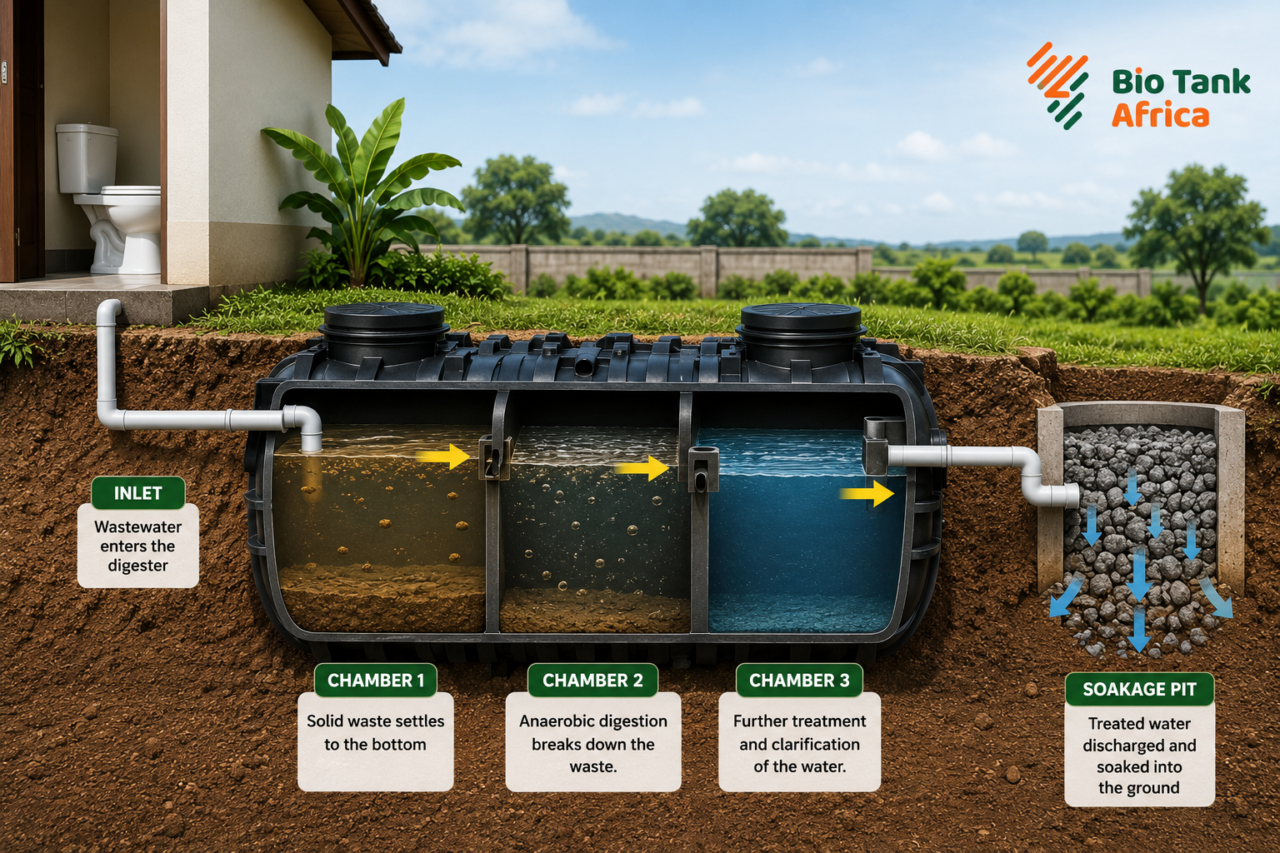
Bio Tank Africa’s ready-made biodigester units are three-chamber systems. The effectiveness of the system rests on six engineering principles working together: wastewater moves progressively through the treatment chambers under controlled flow; heavy solids settle naturally through sedimentation; bacteria break down organic waste through anaerobic digestion; continuous digestion delivers ongoing sludge reduction; remaining solids are separated through clarification; and as new wastewater enters, treated effluent is displaced and exits the system.
Here is what happens inside each chamber:

Chamber One: Primary Digestion
All household waste enters the first chamber through the inlet pipe. This is where the heaviest solids settle and where anaerobic digestion begins. The bacteria in this chamber start breaking down solid organic matter. Gases produced by digestion, mainly carbon dioxide and small amounts of methane, escape safely through the vent pipe. The chamber is sealed and airtight except for the vent, which is why there is no smell above ground.
Chamber Two: Secondary Treatment
Partially digested liquid moves from the first chamber into the second through a submerged port. This submerged connection ensures floating matter and heavy solids remain in the first chamber. In the second chamber, bacterial activity continues and more organic material is broken down. The liquid at this stage is significantly cleaner than what entered the first chamber.
Chamber Three: Final Polishing
The liquid moves into the third chamber for final treatment. By this point, most of the organic load has been digested. What remains is a relatively clear liquid effluent, far cleaner than what a conventional septic tank discharges. This treated effluent flows out through the outlet pipe into the soakage pit, where it is safely absorbed into the surrounding soil.
The Role of Bacteria in the Biodigester Septic Tank
The bacteria doing all this work are naturally occurring anaerobic microorganisms. They exist in human waste and are present in the environment. A biodigester septic tank gives them an ideal, sealed, oxygen-free environment in which to thrive. These bacteria consume human waste, organic solids, proteins, fats, and carbohydrates, converting them into simpler compounds, stabilised sludge, small quantities of biogas, and water.
When a biodigester septic tank is first installed, it needs to be seeded and activated. Bioclean Septic is a standard-strength activated microbial enzyme formulation containing Bacillus species bacteria. Once introduced into the system with water, it accelerates natural sludge decomposition, reduces odour-causing gases, and maintains a healthy microbial balance. Bioclean Septic Plus is a high-strength version at up to ten times the concentration, recommended for larger systems or where there are existing problems such as persistent odour, clogged pipes, or backflow.
The main enemies of biodigester bacteria are bleach, strong antibacterial disinfectants, and certain pharmaceutical chemicals. Using Tazo Natural Home Cleaners a 99.9% chemical-free, biodigester-safe range that includes a natural toilet cleaner, dishwasher gel, and kitchen drain cleaner which protects the bacterial ecosystem and keeps the system performing at its best.

What Comes Out of a Biodigester Septic Tank?
A functioning biodigester septic tank produces three outputs:
Treated liquid effluent — this goes into the soakage pit. It contains no solid matter and has significantly lower levels of pathogens and organic pollutants compared to what a conventional septic tank discharges. According to NEMA Kenya, properly treated biodigester effluent meets approved environmental disposal standards.
Biogas — a small amount of carbon dioxide and trace methane is produced and vented safely through the vent pipe. At the domestic scale of Bio Tank Africa’s units, this gas is not captured for use, but its release is odour-free and safe.
Minimal residual sludge — because the bacteria are continuously digesting solid matter, very little sludge accumulates over time. This is why a well-maintained biodigester septic tank rarely needs emptying.
The Soakage Pit: Why It Matters
The soakage pit receives the treated liquid effluent and allows it to be absorbed into the surrounding soil. Think of it as the final stage of the treatment process; a properly functioning biodigester without an adequate soakage pit is comparable to a vehicle with a working engine but no wheels.
The soil itself acts as a final polishing filter: it physically traps remaining suspended solids, hosts microorganisms that continue breaking down residual organic matter, and allows plants to take up nutrients in the treated effluent.
The success of the soakage pit depends heavily on your soil type. Here is how different soil types perform:
| Soil Type | Percolation Performance |
|---|---|
| Gravel | Excellent |
| Sandy Soil | Very Good |
| Sandy Loam | Good |
| Loam | Moderate |
| Clay Loam | Poor |
| Clay | Very Poor |
In clay-heavy areas like parts of Athi River and Thika, a larger soakage pit or additional drainage work may be required. Your fundi should size and position the soakage pit based on your soil type, the groundwater level, available space, and expected daily wastewater volume.
For more on maintaining your system after installation, visit our Maintenance Tips page.
Does a Biodigester Septic Tank Ever Need Emptying?
A correctly sized, properly installed biodigester septic tank that is used and maintained as recommended should rarely need desludging under normal conditions. The continuous bacterial activity means solid waste is broken down as it enters, leaving very little accumulation over time.
Periodic use of Bioclean Septic supports this process and prevents any gradual buildup from slowing the system down. Bio Tank Africa recommends a minimum of two packets of Bioclean Septic as part of every new installation to seed the system from day one, with regular maintenance doses every one to three months thereafter.
Contrast this with a conventional septic tank, which requires desludging every one to three years at costs starting from KSh 5,000 to KSh 15,000 per visit, and higher in emergencies.
How a Biodigester Septic Tank Compares to a Conventional Septic Tank
A conventional septic tank is passive. It stores and partially separates waste but does very little active treatment. The liquid that flows out into the soakage pit is only partially treated and carries a meaningful contamination risk, particularly in areas with shallow water tables.
A biodigester septic tank actively treats the waste. The effluent it discharges is cleaner, the system rarely needs emptying, and there is no odour when correctly installed.
For a full side by side comparison, read our Septic Tank vs Biodigester in Kenya 2026 guide.
And if you are comparing plastic vs concrete biodigester systems, our Plastic Biodigester vs Concrete Biodigester in Kenya guide covers this in detail.
Which Biotank Unit Is Right for Your Household?
Selecting the correct size is one of the most important decisions you will make. An undersized biodigester septic tank will be overwhelmed by the waste load, reducing treatment efficiency and increasing maintenance requirements. When in doubt, always size up.
The right unit depends on the number of continuous users, your occupancy type, water consumption patterns, and whether you plan to expand in future. Here is a breakdown of all four models:

Biotank Compact — Up to 10 Users — KSh 45,500
Volume: 1.0 m³ | Dimensions: 1,800 × 1,000 × 1,000 mm
Best for bedsitters, granny flats, and small family homes. If you are building a single residential unit with a small household, this is your entry point. Do not install this model if you anticipate your household growing beyond 10 regular users.
Biotank Standard — Up to 15 Users — KSh 59,000
Volume: 1.5 m³ | Dimensions: 1,930 × 1,100 × 1,100 mm
Designed for medium family homes and small offices. A 3 to 4 bedroom family home with regular guests fits comfortably within this range. Also suitable for small offices with consistent daily occupancy.
Biotank Plus — Up to 25 Users — KSh 71,500
Volume: 2.0 m³ | Dimensions: 2,300 × 1,220 × 1,220 mm
The right choice for larger homes, shared compounds, and small rental units. If you are building rental bedsitters or a compound that will house multiple households, start here. This model is also well suited to small commercial applications.
Biotank Max — Up to 40 Users — KSh 115,000
Volume: 2.5 m³ | Dimensions: 2,700 × 1,220 × 1,220 mm
Built for high-occupancy residential and commercial properties including boutique hotels, hostels, schools, churches, and apartment blocks. If your property generates high daily wastewater volumes or has peak usage periods, this is the model to install.
Three questions to help you choose the right size:
- How many people will use the system daily?
- Is the property residential, commercial, or institutional?
- Do you expect the number of users to grow in future?
Not sure which size fits? Visit our Biodigester Systems page or contact us and we will help you choose based on your specific situation. Prices do not include delivery or fundi labour.
Read our Biodigester Cost in Kenya (2026) guide for the full breakdown.
What Customers Are Saying
Over 7,000 homes and businesses across Kenya have made the switch to Biotank. Hear directly from one of them:
“Doing research online I realized that a concrete septic system has high expensive cost in terms of installation. Having the Biotank biodigester for the past 2 years I would recommend it to anybody because of the low maintenance cost which comes with the system. It’s a cheap system in terms of the whole installation process because it’s a plug and play system.”
— Rafael Kibari Motito, homeowner, Tora Estate
Watch Rafael’s Full Story on YouTube
Want to see more? Visit our YouTube channel for more customer stories and installation walkthroughs.
Frequently Asked Questions: How Does a Biodigester Septic Tank Work?
Does a biodigester septic tank need electricity to work?
No. The biological digestion process is entirely natural and requires no electricity or mechanical input. The system works by gravity and bacterial activity alone.
How long does it take for a biodigester septic tank to start working after installation?
With Bioclean Septic used at startup, the bacterial ecosystem typically establishes within one to two weeks. The system reaches full performance capacity within four to six weeks of regular use. You can get Bioclean Septic or Bioclean Septic Plus directly from Bio Tank Africa.
Can a biodigester septic tank handle all types of household waste?
A biodigester septic tank handles human waste effectively. It should not receive non-biodegradable materials, sanitary products, diapers, wet wipes, large quantities of cooking oils and fats, or storm water. A grease trap installed before the biodigester helps manage kitchen wastewater.
What is the soakage pit and why does it matter?
The soakage pit receives the treated liquid effluent from the biodigester and allows it to be absorbed safely into the soil. It must be correctly sized and positioned based on your soil type. A poorly designed soakage pit is one of the most common causes of biodigester performance problems.
How does a biodigester septic tank prevent odour?
The system is fully sealed except for the vent pipe. Anaerobic digestion in a sealed environment does not produce the foul smells associated with open sewage or an overflowing septic tank. As long as the unit is properly installed and the inlet and outlet pipes are correctly sealed, there is no odour above ground.
How is a biodigester septic tank different from a conventional septic tank?
A conventional septic tank stores waste passively and requires regular emptying. A biodigester septic tank actively digests waste using bacteria, produces cleaner effluent, and rarely needs emptying. Read the full comparison: Septic Tank vs Biodigester in Kenya 2026
Do I need a fundi to install a biodigester septic tank?
Yes. The unit comes with a detailed installation manual and any competent plumber can install it in one to two days. You can find a trained installer through our Fundi Forum or use your own plumber.
Ready to Install a Biodigester Septic Tank in Kenya?
Bio Tank Africa supplies ready-made biodigester systems across Kenya. We deliver countrywide.
Shop Now | Contact Us for a Quote | WhatsApp Us
Call or WhatsApp: +254 709 006 300